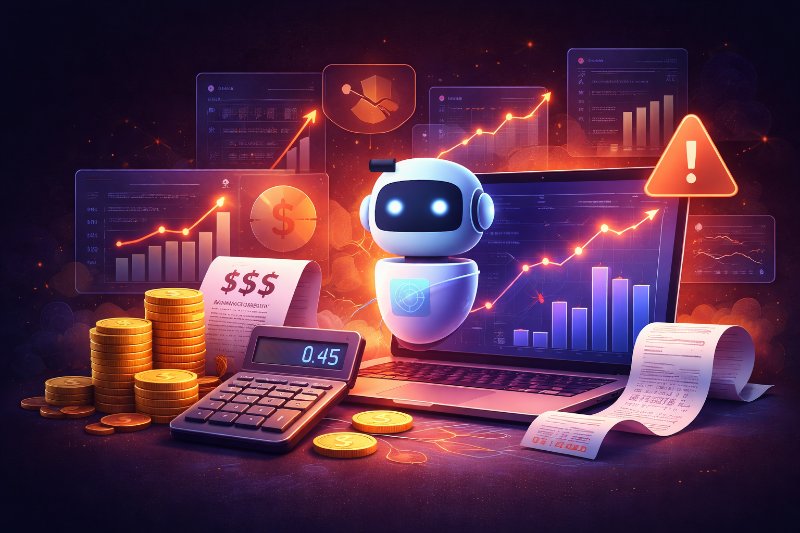
The Real Cost of Running AI in Production
Everyone looks at model pricing first.
Tokens in. Tokens out.
It feels concrete. Manageable.
That's not where the real cost lives.
After building and operating AI-powered apps and seeing the same patterns through AI consulting work, I've learned that models are the cheapest part of the system. The rest is where budgets quietly disappear.
Here's what actually drives cost once AI leaves the demo stage.
Start With the Illusion of Cheap AI
A prototype can run on pocket change.
Production cannot.
The gap comes from everything around the model:
- Reliability work
- Monitoring and retries
- Human safeguards
- Edge cases you didn't plan for
AI pricing looks flat.
Operational cost never is.
1. Token Costs Grow Faster Than Usage
Token math feels simple until reality hits.
What usually increases spend:
- Retries after failures
- Longer prompts over time
- System instructions growing silently
- Multi-step chains instead of single calls
In one AI chatbot project, token usage doubled in three months without adding users. Prompts just got "a little safer" each sprint.
2. Latency Costs Are Hidden but Real
Slow AI isn't just a UX problem.
It's an infrastructure problem.
Teams pay for:
- ➤ Longer-running servers
- ➤ More concurrent workers
- ➤ Higher timeout thresholds
- ➤ Streaming pipelines
In workflow automation, a 4-second delay multiplied across thousands of runs becomes real money.
3. Failures Multiply Costs Quietly
Every failure costs more than one request.
Typical failure amplification:
- Initial request fails
- Automatic retry fires
- Fallback logic triggers
- Logging and alerts run
That's four costs for one user action.
In CRM automation tied to HubSpot, retries alone added ~22% to monthly AI spend before anyone noticed.
4. Human-in-the-Loop Isn't Free
Everyone agrees humans should review critical actions.
Few budget for it properly.
Human review adds:
- 1️⃣ Review tooling
- 2️⃣ Operational time
- 3️⃣ Training and calibration
- 4️⃣ Slower throughput
AI reduces manual work, but it rarely removes it entirely.
5. Monitoring Is a Permanent Expense
AI systems don't degrade loudly.
They drift.
To catch that, teams invest in:
- Quality metrics
- Output sampling
- Feedback pipelines
- Prompt version tracking
Silent quality degradation costs more than outages because it lasts longer.
6. Vendor Risk Has a Price Tag
AI providers go down.
Or slow down.
Or change behavior.
Mitigations cost money:
- Provider abstraction layers
- Secondary model integrations
- Graceful degradation paths
- Manual overrides
In e-commerce flows, keeping a "no-AI mode" ready saved revenue, but not engineering time.
7. Workflow Complexity Is the Biggest Multiplier
AI rarely runs alone.
It sits inside workflows.
Every integration adds cost:
- More failure points
- More retries
- More logging
- More testing
In automation-heavy systems, complexity, not model choice, becomes the main budget driver.
8. Cost Control Is a Design Problem
The cheapest AI systems are designed that way from day one.
Teams that control spend usually:
- ➤ Set hard per-user limits
- ➤ Cache aggressively
- ➤ Shorten prompts ruthlessly
- ➤ Tier AI features by value
One product cut costs by 35% by refusing to "improve" prompts unless it moved a business metric.
Final Reflection
Running AI in production isn't expensive because models cost money.
It's expensive because reliability, trust, and scale cost money.
AI doesn't replace systems.
It demands better ones.
If you treat AI like a feature, costs will surprise you.
If you treat it like infrastructure, costs become predictable.
That mindset shift saves more money than any pricing negotiation ever will.